Compare
OpenClaw vs Hermes Agent: Which agent harness fits your workflow in 2026?
Two open-source agent runtimes with opposite strengths — orchestration versus self-improving automation.
OpenClaw is a multi-channel control plane for persistent agent teams. Hermes Agent is a lean personal runtime that learns from repeated work. Different failure modes, not interchangeable replacements.
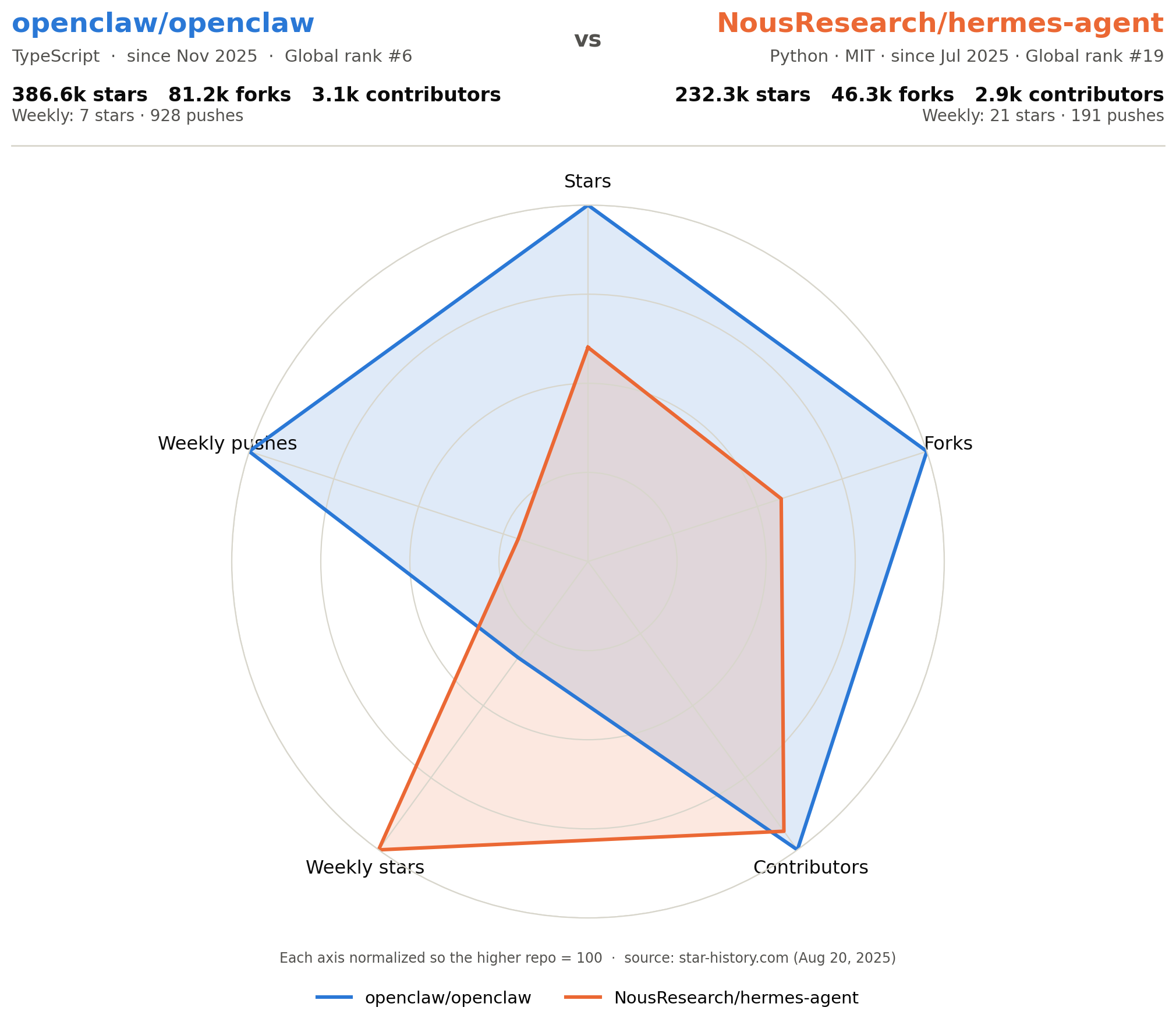
Model quality stopped being the whole story around 2025. What matters now is the harness: how memory is retrieved, how tools show up in the UI, how channels bind, and whether the system learns from your repeats.
OpenClaw and Hermes sit on opposite sides of that tradeoff. We compared them the way we compare architectures in the agent encyclopedia — by loops you can watch, failure modes you hit on day three, and where each runtime still annoys you.
TL;DR
- OpenClaw wins when the problem is coordination: multiple channels, persistent agent teams, and a mature skill marketplace.
- Hermes wins when the problem is repetition: cron-friendly background jobs, lean memory, and workflows that improve over time.
- OpenClaw feels like managing an agent organization. Hermes feels like training a single operator.
- Pick OpenClaw for orchestration across Slack, Telegram, email, and ops. Pick Hermes for daily automations on a VPS.
- Our pick: OpenClaw for multi-agent systems. Hermes for personal automation loops that should get sharper every week.
What we compared
We grouped the evaluation into the buckets that matter when you are building with agents — not marketing slides.
- Architecture — teams, channels, background execution
- Memory & retrieval — context bloat vs tiered search
- UX & control — transparency, interruption, model routing
- Ecosystem — marketplace maturity vs self-learning skills